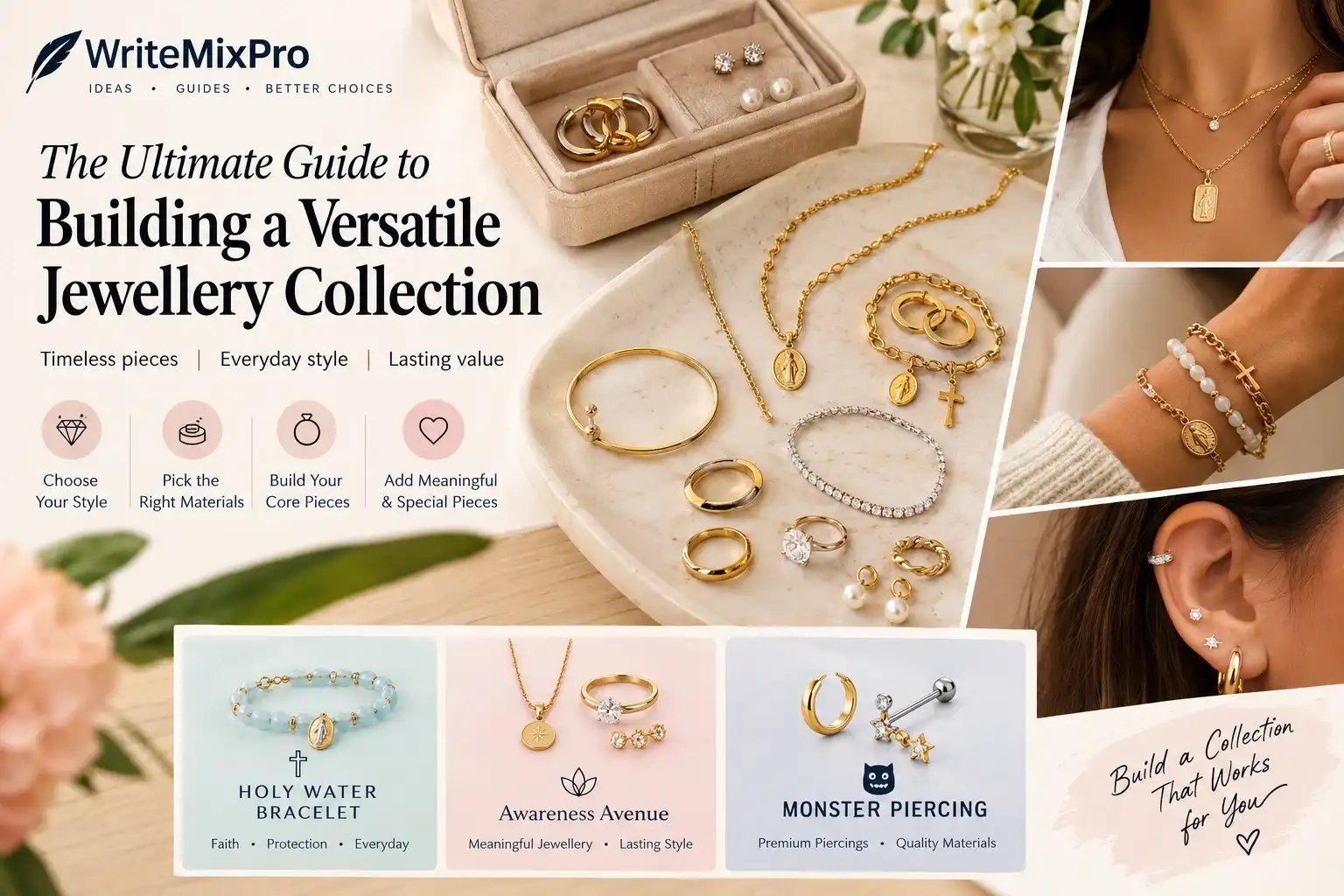
The Ultimate Guide to Building a Versatile Jewellery Collection
Build a versatile jewellery collection with everyday essentials, skin-friendly materials, layering tips, care advice, and meaningful pieces for every occasion.
Recent Blogs
-
Jewellery and Piercings: Expressing Your Personal Style Through Accessories
-
Small Accessories, Big Impact: Ways to Elevate Everyday Outfits
-
How to Style Bracelets, Necklaces and Piercing Jewellery Together
-
Best Everyday Jewellery and Accessories for Every Personal Style
-
The Ultimate Guide to Building a Versatile Jewellery Collection
-
A Practical Guide to Everyday Pet Care: Comfort, Protection, and Hygiene
-
How to Choose the Right Pet Walking Gear for Safety, Comfort, and Control
By William Ashby
·October 15, 2026
Most people do not have a jewellery shortage. They have a jewellery mismatch: a few favourite pieces worn on repeat, and a drawer full of things that tarnish, itch, clash with each other, or only suit one outfit.
A versatile collection fixes that. It is smaller than you might expect, built around how you actually live, and made of materials that cope with real life. This guide gives you a simple order of operations: lifestyle first, materials second, pieces third.
Quick answer: To build a versatile jewellery collection, choose one or two metal tones you wear most, pick skin-friendly materials that survive daily wear, buy around ten core pieces (studs, hoops, a chain, a bracelet, a ring), then add a few meaningful and special-occasion items. Spend more on what you wear daily and less on trend pieces.
What makes a jewellery collection versatile?
A versatile collection is one where most pieces can be worn together and across different settings (work, casual, evenings out) without a rethink. Three things create that: a consistent colour palette, durable materials, and a mix of sizes (small, medium, statement) so you can dress up or down by adding or removing pieces.
It is not about owning the most. A collection of twenty well-chosen pieces usually outperforms sixty random ones.
Step 1: Start with your daily life
Before you look at any product, answer four questions:
- What do you wear most? Tailored workwear, athleisure, dresses, uniforms?
- What are your hands and ears doing all day? Typing, cooking, training, childcare? Rings and bracelets that snag are not versatile.
- Do you shower, swim, or exercise in your jewellery? If yes, water-resistant materials matter more than looks alone.
- Is your skin sensitive? If metals have irritated you before, material choice becomes your first filter.
Write the answers down. They will tell you more about what to buy than any trend list.
Step 2: Choose materials before styles
Material decides comfort, longevity, and price. A beautiful design in the wrong metal ends up unworn.
If your skin is sensitive: nickel is the most common culprit. The American Academy of Dermatology explains nickel allergy and how it shows up, and the Association of Professional Piercers recommends biocompatible materials such as implant-grade titanium for fresh and healing piercings. If you suspect an allergy, see a dermatologist rather than guessing.
If you are shopping for gold: in the US, the Federal Trade Commission's Jewelry Guides set out how terms like karat, gold-plated, and vermeil may be used, which helps you read product descriptions critically. Look for stated karats and clear material names rather than vague words like "gold tone".
The three stores covered in this guide each lean on different materials. Monster Piercing lists solid gold, 925 sterling silver, G23 titanium, and 316L surgical steel. Awareness Avenue lists stainless steel, 925 sterling silver, 18K gold vermeil, and solid gold pieces. Holy Water Bracelet describes its bracelets as made with waterproof stainless steel with gold plating, or crystal pearl.
Step 3: Build the core (the 10-piece foundation)
This is the part of the collection that does the heavy lifting. Aim for pieces you can wear without thinking.
- Small studs (everyday ear baseline)
- One pair of small hoops or huggies
- A fine chain necklace (16–18 inches)
- A pendant or short statement chain for layering
- A simple bangle or chain bracelet
- A second, slimmer bracelet for stacking
- A plain band ring
- A statement ring (shape or stone you love)
- A watch (optional, but a strong anchor if you wear one daily)
- One wildcard (an anklet, brooch, or an unusual earring)
Where you can, pick one dominant metal tone for most of the ten and let the rest be accents.
Where to look: Awareness Avenue sells rings, bracelets, necklaces, earrings and men's jewellery in its core ranges, including stainless steel pieces such as band rings and chain bracelets alongside sterling silver and gold vermeil. If you want to compare several of these foundations in one place, you can browse its bracelets, necklaces and rings. Its site also notes a lifetime warranty and free shipping over USD $110 at the time of writing, but check current terms before buying. Some customer reviews on its own page mention slower delivery, so it is worth allowing extra time if you are buying for a date.
Step 4: Mix metals and layer with confidence
Yes, you can mix gold and silver. The rules that make it look intentional:
- Pick a lead metal. Roughly two-thirds of what you wear should be one tone.
- Bridge the gap. One two-tone piece (or a pendant that combines both) ties the metals together.
- Mix within a zone, not randomly. All silver on the hands, gold in the ears, for example, looks planned.
- Vary lengths. Layered necklaces should differ by about 2–3 cm so chains do not tangle or stack as one thick line.
- Mix texture, not just colour. A smooth band with a hammered one, a sleek chain with a beaded one.
- Edit before you leave. If you are unsure, remove one piece.
For stacking bracelets, one chunky piece plus two fine ones usually reads better than five similar ones.
Step 5: Add meaningful pieces
A versatile collection is not only a style system. Many people want at least one piece that carries meaning: a faith symbol, a memorial, a gift from someone they love, or a milestone.
The practical trick is to choose meaningful pieces in a form that fits your daily wear, so they actually get worn.
Holy Water Bracelet is a faith-jewellery brand whose bracelets feature a resin charm that, according to the brand, contains authentic water from the Grotto of Lourdes in France. Its collections include crosses, saints, Miraculous Medal, hearts, Red Cardinal (often chosen as a memorial gift), personalised styles, plus men's and children's sizes. The brand states its bracelets use waterproof beads so they can be worn in the shower, and that each comes with a one-year guarantee.
Why this fits a versatile collection: a stretch-cord bracelet is easy to stack with a watch or a fine chain bracelet, and the brand's gift sets make it a simple present. If this kind of piece is relevant to you or someone you are buying for, you can explore the Holy Water Bracelet collections. It will not suit everyone, and that is fine: the same principle applies to a birthstone, a locket or a family heirloom.
Step 6: Curate your ears
Ears are where a collection can feel most personal, and also where materials matter most. Piercings sit against skin for hours, and healing piercings should only hold appropriate jewellery.
A simple ear plan:
- Lobes: one pair of small studs, one pair of hoops or huggies.
- Upper ear (helix, tragus, conch): flatback studs or hinged clickers, chosen for comfort.
- Mix sizes: one slightly larger accent per ear, the rest small.
- Choose a style per ear: minimal, sparkly, or edgy. Pick one, then vary.
A note on healing: do not swap jewellery in a fresh piercing without your piercer's advice. Ask them what size and material suit you before buying.
Monster Piercing is a UK body-jewellery store. It lists G23 titanium, 316L surgical steel, 925 sterling silver and 9K, 14K and 18K gold, across labrets, hinged segment clickers, nose studs, belly rings, barbells and aftercare. Flatback labrets and hinged clickers are common choices for a mixed ear. If you are comparing materials for helix, tragus or nose, you can browse Monster Piercing's titanium, steel and gold options. Its site also shows free UK shipping over £20 and 30-day returns, so check the current policy for your location.
Step 7: Add a few special-occasion pieces
Once your daily foundation works, add a small number of pieces for dressing up: a pair of drop earrings, a cocktail ring, a birthstone pendant, or an eternity-style band.
Two practical tips:
- Match the occasion piece to your lead metal, so it works with your core pieces.
- Consider lab-grown or simulated stones if you want sparkle at a lower price. Moissanite and cubic zirconia are common options. Ask any seller for clear stone descriptions.
Awareness Avenue also sells moissanite rings, birthstone jewellery and personalised gifts. On its site, the brand describes using simulated, ethically sourced or lab-grown stones with recycled metals. You can see Awareness Avenue's birthstone and moissanite ranges if you want to compare special-occasion options, but a collection works perfectly well without them.
A simple budget split
A useful rule of thumb (not a research-backed formula, just a planning aid):
- 60% on daily-wear core pieces (studs, chain, band, bracelet)
- 25% on one or two special pieces you will keep for years
- 15% on trend and fun pieces
If you have sensitive skin, put more into the first group and buy fewer, better items.
Care and storage basics
- Put jewellery on last (after perfume, lotion, hairspray) and take it off first.
- Store pieces separately and dry to limit scratches and tarnish, especially silver.
- Wipe daily-wear pieces with a soft cloth.
- Check the seller's care guide: water, chlorine, and sweat affect plated and sterling pieces differently, even where a brand says a product is waterproof.
- Inspect clasps and settings every few months.
Common mistakes to avoid
- Buying trends before you have a base.
- Ignoring material when skin is sensitive.
- Buying many pieces of the same design.
- Treating "gold-tone" as gold.
- Skipping size checks for rings and bracelets (use the store's size guide).
- Changing jewellery in a healing piercing too early.
A 30-day starter plan
- Week 1: Audit what you own. Keep what you wear, set aside what irritates your skin.
- Week 2: Choose lead metal and fill the biggest gap in the 10-piece core.
- Week 3: Add one meaningful piece and one ear upgrade.
- Week 4: Test outfits, edit, and decide what, if anything, to add for occasions.
Frequently Asked Questions
1. What jewellery should I buy first?
Start with everyday basics: small stud earrings, a fine chain necklace, a simple band ring, and a slim bracelet in one metal tone you wear most.
2. How many pieces does a versatile collection need?
About ten core pieces cover most outfits. Add a few meaningful and occasion pieces after that.
3. Can I mix gold and silver jewellery?
Yes. Choose a lead metal, add one bridge piece that combines both, and keep metals grouped by area (for example, silver on hands, gold in ears).
4. Which metals are best for sensitive skin?
Implant-grade titanium, solid gold in higher karats, and some stainless steels are commonly chosen. Nickel is a frequent irritant, so check material details and see a dermatologist if reactions persist.
5. Is gold vermeil real gold?
Vermeil is a layer of gold over sterling silver. It is not solid gold, and the coating can wear with heavy use. Rules on how the term may be used vary by country.
6. Is stainless steel jewellery waterproof?
Stainless steel itself resists water well, but finishes such as plating can still wear over time. Check each brand's care guidance rather than assuming.
7. How do I stop silver jewellery from tarnishing?
Store it dry and separate, put it on after cosmetics and perfume, and wipe it with a soft cloth after wearing.
8. Can I change jewellery in a new piercing?
Not until your piercer says it is healed. Ask them which size and material to use.
Conclusion
A versatile jewellery collection is a system, not a shopping list. Start with how you live, choose materials that suit your skin and routine, build a small core, then layer in the personal and the special. Do that in order, and most of what you buy will actually get worn.