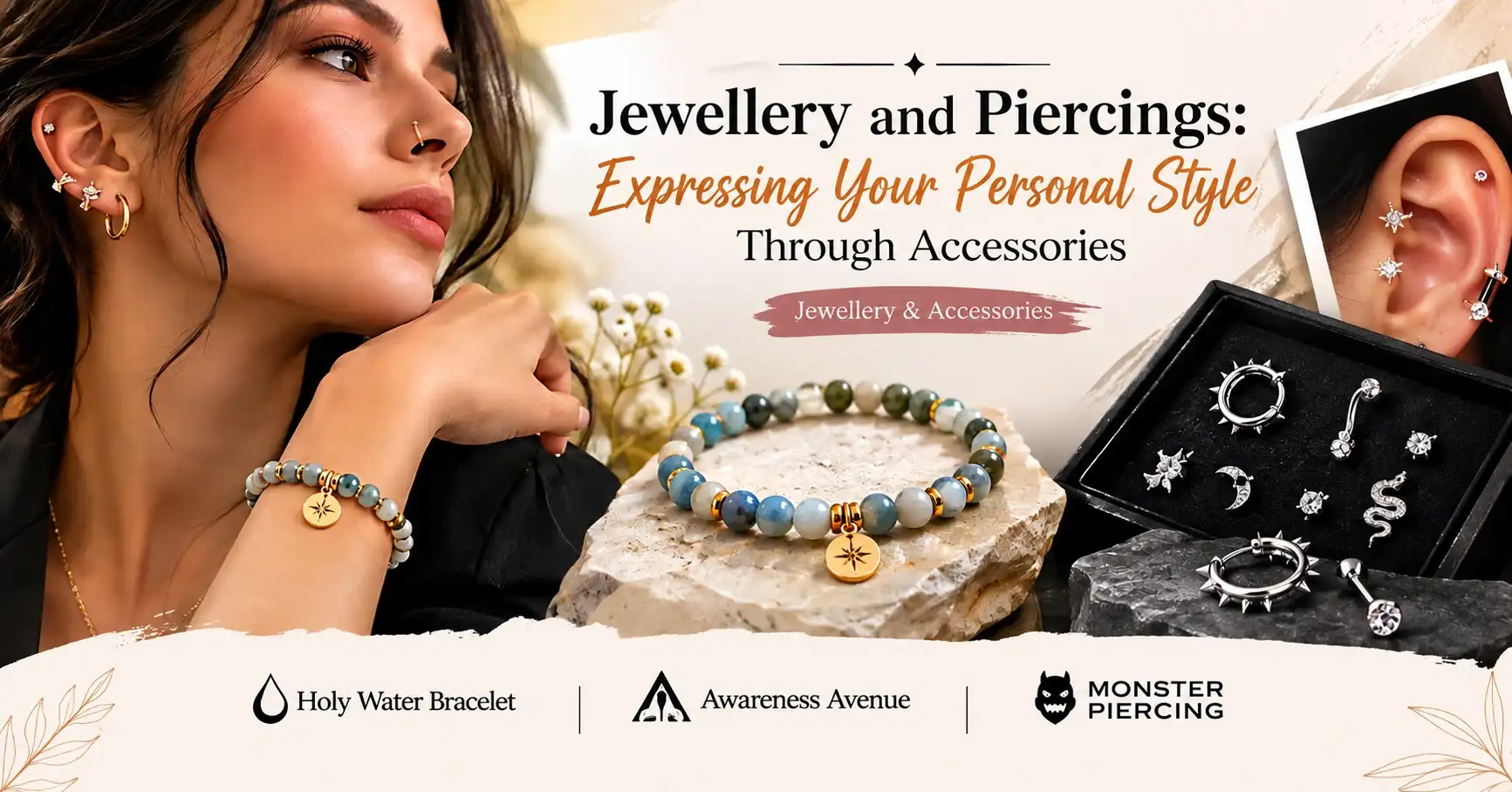
Jewellery and Piercings: Expressing Your Personal Style Through Accessories
Discover how to express your personal style with meaningful jewellery, everyday accessories, curated piercings, safe materials, and effortless layering tips.
Recent Blogs
-
Jewellery and Piercings: Expressing Your Personal Style Through Accessories
-
Small Accessories, Big Impact: Ways to Elevate Everyday Outfits
-
How to Style Bracelets, Necklaces and Piercing Jewellery Together
-
Best Everyday Jewellery and Accessories for Every Personal Style
-
The Ultimate Guide to Building a Versatile Jewellery Collection
-
A Practical Guide to Everyday Pet Care: Comfort, Protection, and Hygiene
-
How to Choose the Right Pet Walking Gear for Safety, Comfort, and Control
By William Ashby
·October 15, 2026
A plain gold hoop. A bracelet that carries a memory. A small cluster of studs climbing one ear. None of these is a trend. Each is a small decision about who you are, and together they say more than most outfits do.
The hard part is making those decisions work as a whole. Pieces bought on impulse don't always go together. Some metals irritate skin. And a new piercing raises questions about materials and healing that a regular jewellery guide never answers.
This guide covers how to find your style direction, how to choose meaningful everyday jewellery, how to plan piercings and pick body-safe materials, and how to layer it all so it looks deliberate. Along the way, it points to three stores worth browsing for different needs.
How do jewellery and piercings express personal style?
Jewellery expresses personal style when three things line up: what it means to you, how it looks with the way you dress, and whether you can wear it comfortably every day. Piercings add a fourth factor. Body jewellery sits in a healing or healed opening in the skin, so material, fit and quality matter as much as appearance.
A useful test for any piece is to ask whether you'd still choose it if no one else saw it. If yes, it's probably yours, not just a trend you're renting.
Start with a style direction
You don't need a quiz. You need two or three words that describe what you already reach for. Use this table to find the closest fit, then borrow from a second column if you like.
Most people land between two directions. A minimal wardrobe with one meaningful bracelet is a perfectly coherent look.
Jewellery with meaning: faith, memory and symbols
Some of the most-worn jewellery is the kind people choose for what it represents: a belief, a loved one, a milestone. That meaning tends to make a piece an everyday staple instead of a drawer item.
If faith or remembrance is part of your style, Holy Water Bracelet is a relevant place to explore. It describes itself as a faith jewellery brand founded by a third-generation Rhode Island jewellery maker. The brand says each bracelet contains water sourced from the Grotto of Lourdes in France, sealed inside a resin charm. Collections are organised by symbol (cross, Miraculous Medal, saints, hearts, Red Cardinal, butterfly), by occasion, and by recipient, with smaller sizes for children and a larger men's size. Personalised options and a 1-year guarantee are listed on the site.
A few practical details from the brand's own information:
- The beads are stainless steel with waterproof gold plating or crystal pearl, and the brand states the bracelets are waterproof.
- Standard bracelets are designed with a stretch cord and fit most adult wrists, per the brand.
- Prices for the single porcelain-style bracelets started at about $28 at the time of writing.
How a piece is meant to be worn, and what it signifies, is personal. The brand's description of the water is the brand's own, so read its page about the water source and decide whether that meaning fits you. This kind of piece suits readers who want jewellery with a story, or who are buying a gift for someone for whom faith or remembrance is central.
Everyday rings, necklaces and gifts
Not every meaningful piece has to be religious. Birthstones, engraved messages and matching pieces for family or couples do the same job.
Awareness Avenue covers this broader ground. Its range includes rings, necklaces, earrings and bracelets, with collections by stone, metal, design and recipient. It also offers men's jewellery, birthstone and natural-stone pieces, personalised and "to my…" gift styles, and a free guide to browse and shortlist. The brand says it uses simulated, ethically sourced or lab-grown stones with recycled metals, and it advertises a lifetime warranty. Check the terms for what that covers.
Two things help you shop this category well.
Understand the stones. Moissanite is a lab-created gem with very high hardness (about 9.25 on the Mohs scale, against 10 for diamond). It is not a diamond, and it is usually priced far below one. That's a reasonable choice if you want durability and sparkle without diamond pricing, as long as you know what you're buying.
Check delivery and returns before gifting. Some customer reviews on the store's own pages mention longer delivery times, so build in a buffer for gifts with a date attached. Confirm the ring size guide and returns policy before you order anything sized or engraved. That advice applies to any online jewellery purchase.
This store fits readers who want a wide choice of everyday rings and necklaces, gift ideas sorted by recipient, or stone-focused pieces.
Piercings as part of your look
A piercing is the one accessory that becomes part of the shape of your ear or nose. That's why planning matters more here than with a ring you can swap out in a second.
Planning a curated ear
A "curated ear" is a group of piercings and jewellery chosen to work together. A simple way to plan one:
- Pick an anchor. Choose one piece or placement you love, such as a helix hoop or a conch stud, and build around it.
- Vary the scale. Mix one larger piece with small studs so the ear has a focal point instead of competing pieces.
- Keep a consistent palette. Two metal tones or one stone colour across the ear looks intentional.
- Go one at a time if you're unsure. Adding gradually lets you see how each piercing heals and sits before you commit to the next.
- Talk to a professional piercer about anatomy. Not every ear suits every placement, and a good piercer will tell you honestly.
Which piercing jewellery material is right?
Material is the biggest safety decision after choosing a reputable piercer. The Association of Professional Piercers (APP) publishes guidance on suitable materials, and the broad picture is consistent: implant-grade metals are preferred for fresh piercings, and plated or unspecified metals are a gamble.
If you're not sure what a piece is made of, ask the seller. A reputable retailer will state the material and grade.
Where to browse piercing jewellery
Monster Piercing is a UK-based body jewellery retailer. It describes itself as a manufacturer of body jewellery and sells by placement (ear, nose, belly, lip and more) as well as by material. The range includes G23 titanium, 316L steel, 925 sterling silver and 9K–18K solid gold, in styles such as hinged segment clickers, flatback labrets, threadless tops, belly rings and ear stretchers. There is also a sterilised jewellery range, aftercare products, a size guide, and guides to specific piercing types such as helix, tragus, conch and daith.
At the time of writing, many steel and titanium pieces were priced from roughly £5 to £15, with solid gold clickers higher. That makes it practical to experiment with a look before investing in gold. Product pages list the material, and for implant-grade claims such as titanium, that's the detail to look for. Shipping is free over £20 per the store's banner, but check its return policy for body jewellery, since hygiene rules often restrict returns.
This store suits readers who already have piercings and want to refresh them, or who want clear material choices and a wide range of styles.
Healing first, styling second
Fresh piercings are healing wounds, not accessories. Healing time varies by placement, and cartilage generally takes much longer than lobes. Jewellery for a fresh piercing is best chosen with the piercer who did it. Wait until you're fully healed, and your piercer agrees, before swapping to decorative pieces. Follow your piercer's aftercare instructions, which commonly centre on gentle saline cleaning, and see a professional if you notice signs of infection. Age and consent rules vary, and reputable studios will ask for ID.
How to layer without losing your look
- Choose a lead piece. One item gets to be the statement; the rest support it.
- Match tone or contrast on purpose. Mixing gold and silver works when it's repeated, such as one silver ring on each hand with gold elsewhere.
- Vary length and size. Different chain lengths and ring widths look layered instead of cluttered.
- Echo a motif. A repeated shape, stone colour or symbol ties different pieces together.
- Edit before leaving the house. Remove one piece. If the look improves, you had one too many.
Common mistakes
- Buying plated pieces for a new piercing. Plating can wear and expose base metals.
- Ignoring the material description. Vague listings ("surgical metal") deserve questions.
- Over-stacking. Meaningful pieces get lost when everything competes.
- Skipping sizing. Rings and bracelets that don't fit won't be worn.
- Treating gifts as an afterthought. Check delivery windows, returns, and sizing before a deadline.
Quick buying checklist
- Do I know what the piece is made of, and the grade if it's for a piercing?
- Is it comfortable enough to wear daily?
- Does it work with at least three things I already own?
- Do I know the size and the return or exchange policy?
- Is the meaning, if any, genuinely mine (or the recipient's)?
Which store suits which need?
Frequently Asked Questions
How do I choose jewellery that matches my personal style?
Pick two or three words for your style (minimal, meaningful, edgy), then check each piece against what you already wear. Start with one piece you'd wear daily and build outward.
What is the best metal for piercing jewellery?
Implant-grade titanium (ASTM F136) is widely recommended by professional piercers because it contains no nickel. Implant-grade steel and solid gold are also used. Plated jewellery isn't suitable for fresh piercings.
Can I change my piercing jewellery right away?
Not usually. Fresh piercings need time to heal, and the timeline varies by placement. Ask your piercer when it's safe to change jewellery.
Is moissanite the same as diamond?
No. Moissanite is a separate, lab-created gemstone. It's very hard and sparkly, but it's chemically and optically different from diamond and priced much lower.
Is gold-plated jewellery okay for piercings?
Not for fresh piercings. Plating can wear away. Solid gold or implant-grade metals are safer choices for new piercings.
Can I mix gold and silver jewellery?
Yes. Repeat each tone at least twice, or let one piece bridge both, so the mix looks intentional.
Are faith bracelets waterproof?
It depends on the materials. Holy Water Bracelet states its beads are waterproof stainless steel with gold plating or crystal pearl, but check each product's care details.
Conclusion
Personal style comes down to choosing pieces you'd wear without anyone watching, in materials your skin tolerates. Start with a direction, add meaning where it matters to you, treat piercings as a planned part of the look, and layer with a lead piece and a repeated motif. If you'd like somewhere to start, the three stores above cover meaningful bracelets, everyday and gift jewellery, and piercing jewellery. Pick the one that matches your next purchase.