How to Make Your Home More Comfortable for Everyday Living
Make your home more comfortable with simple upgrades for better sleep, lighting, temperature control, pet spaces, and outdoor living without overspending.
Recent Blogs
-
Jewellery and Piercings: Expressing Your Personal Style Through Accessories
-
Small Accessories, Big Impact: Ways to Elevate Everyday Outfits
-
How to Style Bracelets, Necklaces and Piercing Jewellery Together
-
Best Everyday Jewellery and Accessories for Every Personal Style
-
The Ultimate Guide to Building a Versatile Jewellery Collection
-
A Practical Guide to Everyday Pet Care: Comfort, Protection, and Hygiene
-
How to Choose the Right Pet Walking Gear for Safety, Comfort, and Control
By William Ashby
·October 08, 2026
A home rarely feels uncomfortable because of one big flaw. It's usually a pile of small frictions: a pillow that never sits right, a bedroom that fills with light at 5 a.m., a living room that is glaring in the afternoon and harsh at night, a dog with nowhere calm to settle, a patio nobody uses after sunset.
Each one is minor. Together they decide whether home feels like a place you recover in or a place you just pass through.
This guide gives you a simple way to find the frictions in your own home, fix the free ones first, and spend money only where it will make a daily difference. Along the way, it points to a few stores that carry the kinds of products involved, in case you want to explore options.
Quick answer: what makes a home more comfortable?
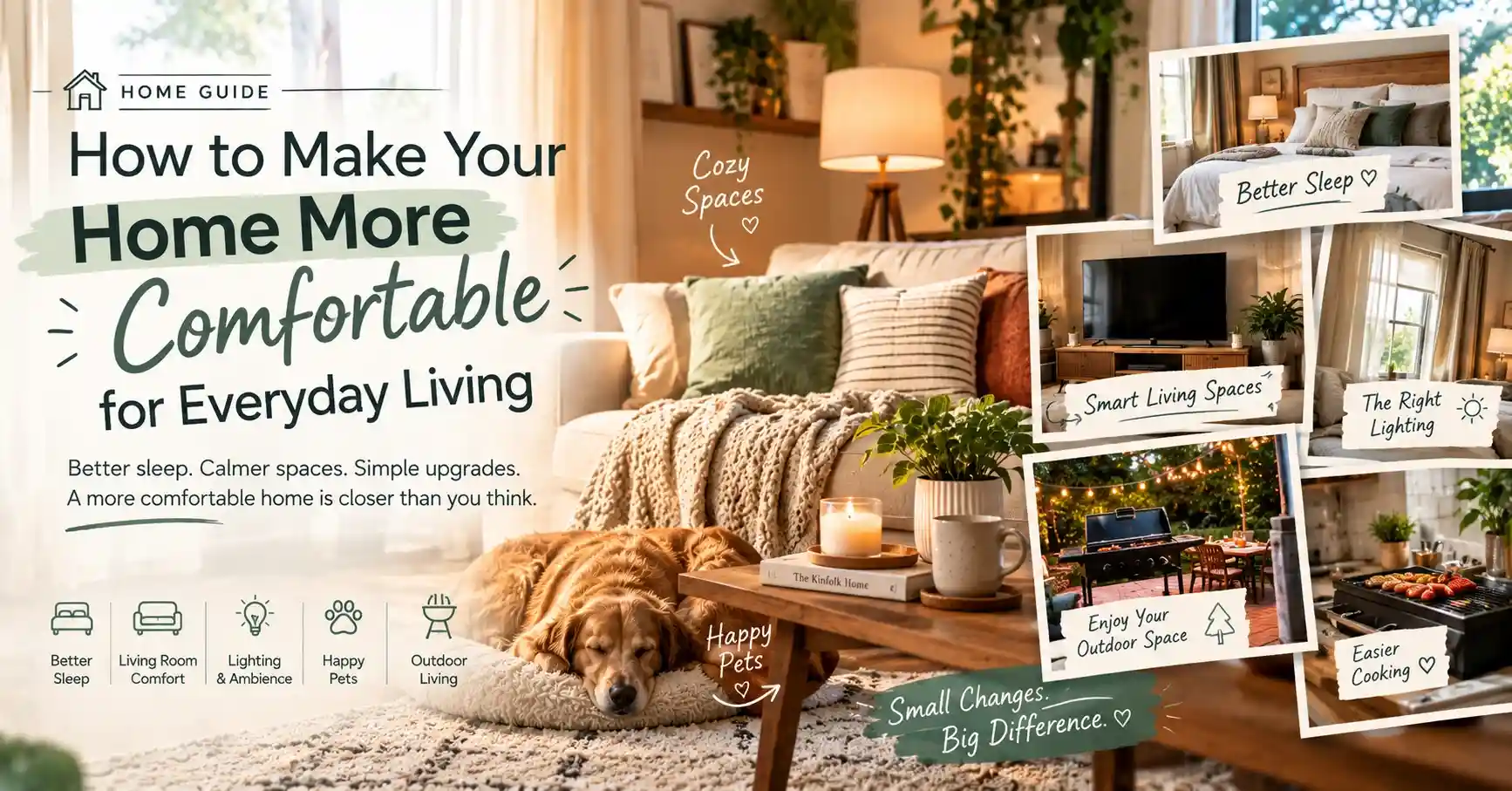
A home feels more comfortable when five everyday things work well:
- Rest: your bed and bedroom support good sleep.
- Light and temperature: windows let you control glare, privacy, and heat.
- Evening atmosphere: lighting is warm and layered, not one harsh overhead.
- Shared space: people and pets each have somewhere calm to settle.
- Outdoor use: balconies, patios, and yards are usable, not just decorative.
Start with whichever one annoys you most often, not whichever is cheapest or trendiest.
What "comfortable" actually means at home
Comfort is practical before it is aesthetic. It comes from how a space handles the things you do every day. It is not about how many cushions you own.
Start with a 15-minute comfort audit
Before buying anything, find out what actually bothers you. This takes one ordinary day.
- Keep a note on your phone. Each time something irritates you (a glare on the TV, a cold draft, a squeaky chair, the dog pacing), add a line.
- Sort the notes into the five layers in the table above.
- Score each item: how often it happens (1–3) × how much it bothers you (1–3).
- Fix the free ones first. Rearranging furniture, opening a window at the right time, and clearing one surface cost nothing.
- Pick one or two purchases from the highest-scoring group. Buy for the problem you wrote down, not for a "look."
People who skip this step tend to buy for the room they imagine rather than the room they live in.
Fix sleep first
If you improve only one area, make it sleep. The U.S. Centers for Disease Control and Prevention (CDC) advises keeping the bedroom quiet, dark, relaxing, and at a comfortable temperature, and keeping devices like TVs and phones out of it. Most of that is arrangement and habit.
Bedding fills in the rest, and the details matter more than the label.
Choose a pillow for how you sleep
- Side sleepers generally need more loft to fill the gap between the shoulder and the head.
- Back sleepers usually do best with a medium loft that supports the natural curve of the neck.
- Stomach sleepers generally want a thinner, softer pillow so the neck isn't pushed back.
- People who change position may prefer an adjustable-fill or two-sided design.
If you wake with persistent neck pain, numbness or tingling, speak to a healthcare professional. A pillow is not a treatment.
Match bedding to your temperature
Some people sleep hot and some sleep cold, and many households contain one of each. Layers help: a lighter comforter you can add to, or a two-part comforter you can zip together or separate. Breathable sheets and cooling pillowcases help hot sleepers. A mattress protector and a throw blanket are low-cost upgrades that often get overlooked.
If you want to browse a single range that covers these categories, MELLOWSLEEP sells pillows (including ergonomic, adjustable, and cooling designs), comforters, sheets, pillowcases, mattress protectors, and throws. Its site states a 30-night trial and a lifetime warranty, which is helpful for something as personal as a pillow. Check the current terms before ordering.
Small upgrades that add up
- A bedside lamp with a warm bulb instead of the ceiling light.
- A fitted sheet that stays put, so you aren't fixing the bed at midnight.
- One consistent spot for your phone charger, away from the pillow.
Control light and temperature at the windows
Windows decide a lot about everyday comfort: morning glare, afternoon heat, evening privacy, winter drafts. They are also easy to get wrong.
The U.S. Department of Energy treats window attachments such as shades, draperies, and blinds as a practical way to reduce unwanted heat loss in cold weather and heat gain in warm weather. Among them, tightly fitted cellular (honeycomb) shades are generally described as the most insulating option. How well any covering performs depends heavily on how closely it fits the window.
Curtains or shades? A quick comparison
Many homes do well with layers: a shade for light and insulation behind a curtain for softness.
Measure properly, or the product won't work
Most disappointment with window coverings comes from sizing, not quality.
-
Mount rods higher and wider than the window frame so curtains clear the glass when open.
-
For maximum light blocking, curtains should be wider than the window and long enough to reach near the floor.
-
Request fabric samples. Colour and texture look different at home than on a screen.
-
Choose cordless designs in homes with young children or pets.
EaseEase Curtains makes custom-size curtains and shades, with options such as blackout, sheer, thermal, and cordless designs. Its site also lists free fabric swatches, a free design service and measuring guides, and says it will remake an item that doesn't fit under its MeasureFit Guarantee. Custom orders take longer than ready-made ones, so allow for lead time.
Get evening light right
Lighting changes how a room feels more than almost any other factor, and it is one of the cheapest to fix.
Inside: use layers, not one bright overhead
Good rooms usually combine three kinds of light:
-
Ambient: the general glow (ceiling fixture or several lamps).
-
Task: focused light where you read, cook, or work.
-
Accent: soft light that adds depth (a shelf light, a small lamp).
For relaxing spaces, warm white bulbs (roughly 2,700–3,000K) generally feel calmer than cool white. Dimmers or smart bulbs let one room serve both dinner and homework. In the bedroom, keep light low and warm before bed, and darkness at night, in line with the CDC advice above.
Outdoors: make the space usable after dark
A patio that is dark at 6 p.m. in winter simply doesn't get used. Outdoor string lights, solar spotlights and rope lights can turn it into an extra room.
Lighting Legends is a UK-based retailer focused on outdoor and connectable lighting, including festoon-style string lights, fairy lights, solar options and warm-white variants. Before buying outdoor lights:
- Check the weather rating (IP rating) on the product page.
- Decide between plug-in (brighter, needs an outdoor socket) and solar (easy to place, varies with sun).
- Measure the run and check whether lights are connectable.
- Confirm delivery and pricing for your country, since this store lists prices in pounds.
Make the outdoors part of everyday life
An outdoor space becomes part of everyday life when it is easy to use on a Tuesday, not only for parties. Lighting helps. So does a simple way to cook and eat outside.
A grill won't make a home comfortable by itself. It can, however, keep heat and cooking smells out of the kitchen in summer and make weeknight dinner feel like a small break.
Grilla Grills sells pellet grills (including its Silverbac line), a kamado-style charcoal grill called the Kong, and a portable pellet model. Here is how the main types differ:
Whatever you choose, follow the manufacturer's clearance instructions. Place the grill on a stable, level surface away from walls, eaves, and dry vegetation. Never use it in a garage or enclosed space. If you live in an apartment, check your lease and local fire rules first.
Give pets and guests a place to settle
A comfortable home includes the animals who live in it. Many dogs settle more easily when they have a defined, den-like space they can retreat to, especially during visits, deliveries, or busy evenings.
If you're considering a crate:
- Size it so your dog can stand, turn around, and lie down comfortably. For puppies, buy for the adult size and use a divider.
- Match the crate to the dog. An escape-prone or anxious dog needs a different design than a calm one that mostly wants a quiet corner.
- Introduce it gradually, with treats and short stays, and never use it as punishment.
- Treat it as a rest space, not all-day confinement. If your dog shows severe distress when left alone, talk to a vet or qualified trainer.
Impact Dog Crates makes aluminum crates in several formats: reinforced models for escape-prone dogs, collapsible travel crates, stationary home crates, and a furniture-style option intended for calm dogs. Its site includes a sizing tool and lists a 30-day trial for customers in the contiguous U.S. Read the current return and warranty terms before purchase.
Free comfort wins
Not every improvement needs a purchase:
- Ventilate on schedule. Open windows briefly when the weather allows, and use exhaust fans when cooking or showering.
- Clear one surface per room. A bare surface makes the room feel calmer than any decoration.
- Create an entryway landing spot for keys, shoes, and bags.
- Rearrange seating so people face each other and the light, not just the TV.
- Do a 10-minute evening reset: lights lowered, blankets folded, tomorrow's bag by the door.
Common mistakes to avoid
- Buying decorative items before fixing sleep, light, or temperature.
- Guessing window measurements, or measuring only the glass.
- Choosing cool-white bulbs for rooms meant for relaxing.
- Buying the biggest crate "so the dog can grow into it" without a divider.
- Treating a pillow or supplement as a substitute for medical advice on pain or sleep disorders.
- Spending on all five areas at once instead of ranking them.
Quick checklist
- Bedroom is dark, quiet, and cool enough at night
- Pillow loft fits my sleep position
- Windows are measured and covered to the right size
- At least two light sources in each living space
- Warm bulbs where I relax
- Pets have a defined resting spot
- Outdoor area is lit and usable after dark
- One free fix done per room this week
Frequently Asked Questions
What makes a home feel comfortable?
Comfort comes from how well a home handles daily needs: good sleep, control over light and temperature, soft evening lighting, calm space for people and pets, and usable outdoor areas.
How can I make my house more comfortable on a budget?
Start with free changes: rearrange seating, clear surfaces, ventilate, and swap harsh overhead lights for lamps. Then buy one thing that targets your biggest daily annoyance.
What is the ideal bedroom setup for sleep?
The CDC recommends a bedroom that is quiet, dark, relaxing, and at a comfortable temperature, with TVs, computers, and phones kept out.
Are blackout curtains worth it?
They help if light disturbs your sleep, such as with early sunrise, street lights, or shift work. They work best when wide enough to overlap the window and long enough to reach near the floor.
Which window covering is best for insulation?
The U.S. Department of Energy describes tightly fitted cellular shades as among the most effective options. Lined, floor-length curtains that fit snugly can also help.
What colour light is best for a living room?
Warm white (roughly 2,700–3,000K) usually feels more relaxing. Use brighter, cooler light only for task areas such as a desk.
How big should a dog crate be?
Large enough for your dog to stand, turn around, and lie down comfortably. For puppies, choose the adult size and add a divider.
Conclusion
A more comfortable home rarely comes from one big purchase. It comes from noticing what bothers you, fixing the cheap things first, and putting money where you feel the difference every day: usually sleep, windows, and lighting.
Pick the highest-scoring problem from your audit and fix just that this week. If any of the stores above carry what you need, they're there to explore. The comfort comes from the fit between your home and your routine, not from owning more.