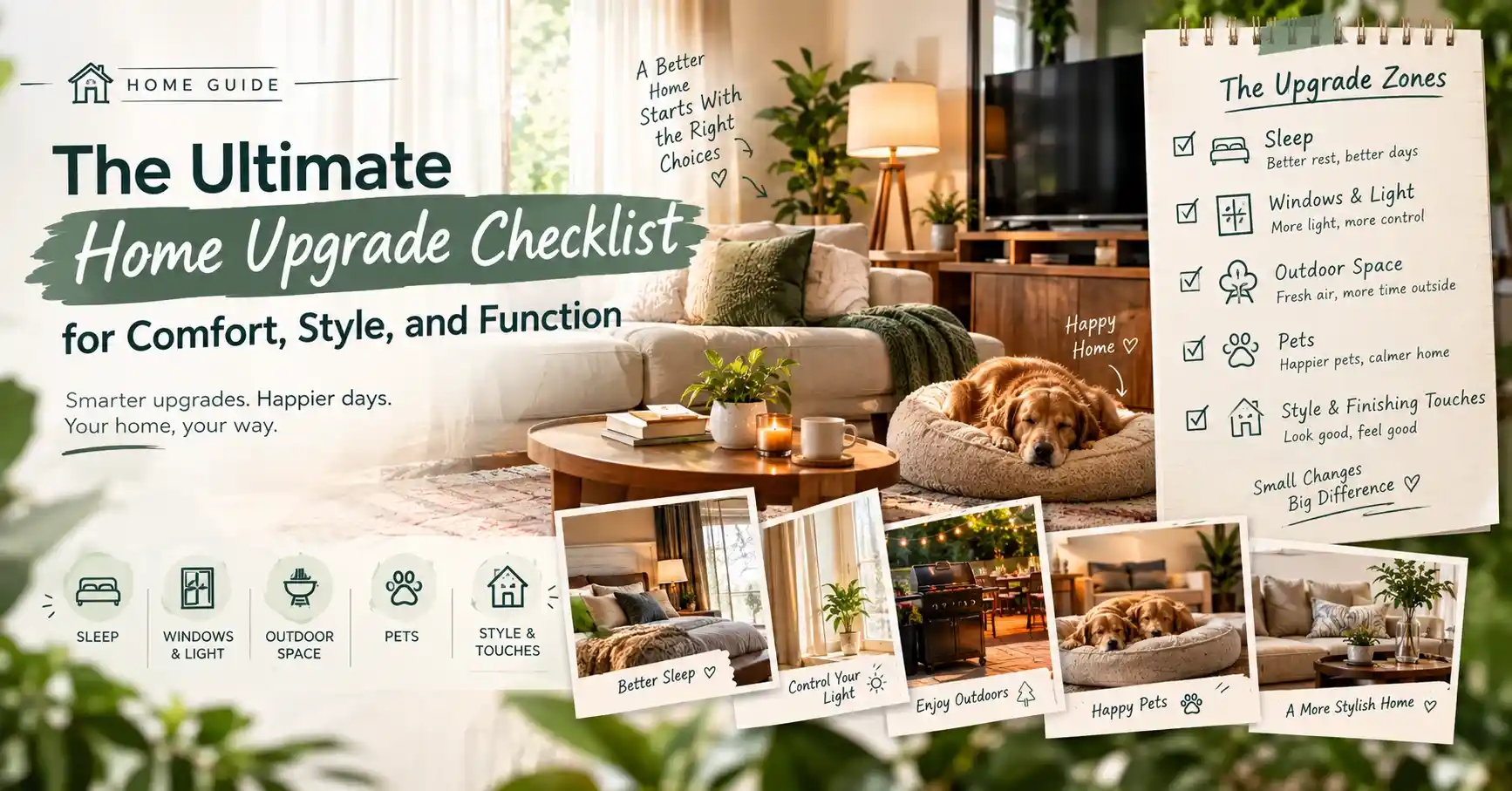
The Ultimate Home Upgrade Checklist for Comfort, Style, and Function
A practical home upgrade checklist covering sleep, windows, outdoor spaces, pets, safety, and style helping you prioritize upgrades that truly improve daily living.
Recent Blogs
-
Jewellery and Piercings: Expressing Your Personal Style Through Accessories
-
Small Accessories, Big Impact: Ways to Elevate Everyday Outfits
-
How to Style Bracelets, Necklaces and Piercing Jewellery Together
-
Best Everyday Jewellery and Accessories for Every Personal Style
-
The Ultimate Guide to Building a Versatile Jewellery Collection
-
A Practical Guide to Everyday Pet Care: Comfort, Protection, and Hygiene
-
How to Choose the Right Pet Walking Gear for Safety, Comfort, and Control
By William Ashby
·October 08, 2026
Most home upgrade lists are really shopping lists. They tell you what to buy, but not what to do first or what you can skip. The result is a half-finished living room, a new gadget nobody uses, and a budget spent before the real problems were fixed.
This checklist goes in a different order. It starts with how you actually use your home, sorts upgrades into five zones, and shows how to sequence them so each purchase earns its place.
Quick answer: what should you upgrade first? In most homes, start with what you use every day or what affects safety and sleep: your bed setup, your window coverings and light control, then your outdoor and pet spaces. Decorative changes come last, because they work better once the basics are fixed.
How to Use This Checklist
You don't need to do everything here. Try this instead:
- Notice friction for a week. Write down every small annoyance: the bedroom that's too bright at 6 a.m., the patio nobody uses after dark, the dog that won't settle at night.
- Run the Comfort / Function / Style test. For each idea, ask whether it improves how the space feels, how it works, or how it looks. Upgrades that improve two or more usually deserve priority.
- Sequence by consequence. Safety first, then daily-use items, then atmosphere, then showpieces.
Zone 1: Sleep, the Upgrade You Use Every Night
Few purchases get as much daily use as what's on your bed. If you're deciding where the first dollar goes, start here.
What to check:
-
Pillow fit. Pillow height and firmness should match how you sleep. Side sleepers generally need more loft than stomach sleepers. If you have persistent neck or shoulder pain, mention it to a clinician rather than expecting a pillow to fix it.
-
Temperature. Hot sleepers and cold sleepers need different bedding. Layers you can add or remove are more forgiving than one heavy option.
-
Protection. A waterproof mattress protector and washable covers extend the life of what's underneath.
-
Return terms. Bedding is personal. A trial period lowers the risk of guessing wrong.
If you're comparing options, Mellow's bedding collection covers most of this zone in one place. It includes ergonomic and adjustable pillows, standard and cooling comforters, a dual-layer comforter that zips together for different temperature needs, cooling sheet sets, a waterproof mattress protector, and throw blankets. The brand lists a 30-night trial and a lifetime warranty, so read the terms for the specific product you choose before buying.
Zone 2: Windows, Privacy, and Light Control
Windows affect light, privacy, glare, noise, and temperature, which makes them one of the best Comfort-plus-Function upgrades in the house.
Match the covering to the job:
The U.S. Department of Energy notes that shades mounted close to the glass work best when drawn, and that layered Roman shades insulate better than most other soft window treatments. Fit matters as much as fabric, because gaps let light and heat through.
Measure before you order. Measure width and height at more than one point, since window frames are rarely perfectly square. Decide on mounting height before you buy, because that choice changes the length you need.
Safety matters here. The Consumer Product Safety Commission recommends cordless window coverings in all rooms where a child may be present, and it marks October as National Window Covering Safety Month. If you have young children, put cordless at the top of your requirements.
For made-to-measure options, EaseEase Curtains sells custom curtains and shades. The range includes blackout, thermal, sheer, linen, and velvet curtains, plus cordless Roman, roller, zebra, and cellular shades. The store offers free fabric swatches, a free design service, measuring guides, and a fit guarantee for orders that don't fit as measured (per the store, requests within 90 days). The swatches are worth using, since fabric looks different in your own light than on a screen.
Zone 3: Outdoor Space, From Lighting to Cooking
A patio, balcony, or garden only gets used if it's comfortable after dark and easy to cook and host in.
Lighting That Makes the Space Usable After Dark
Plan outdoor lighting in layers, as you would indoors:
-
Ambient: string lights or festoon lights overhead for a general glow.
-
Task: brighter light near steps, gates, or the cooking area.
-
Accent: small spotlights on plants or a feature wall.
Color temperature shapes the mood. Warm white (around 2700–3000K) feels relaxed and suits seating areas. Cooler white suits security and task lighting. Choose outdoor-rated products, use outdoor-rated sockets and connectors, and leave fixed wiring to a qualified electrician.
Lighting Legends is a UK-based retailer focused on outdoor lighting. Its range includes heavy-duty festoon string lights, connectable fairy lights in warm and bright white, solar and USB dual-power string lights, solar spotlights, security lights, bulbs, and accessories. It also has a "Help me choose my lighting" page if you're unsure where to start. Prices are in pounds, and delivery terms are UK-focused, so check availability for your region before you order.
Cooking and Hosting Outdoors
A grill changes how often you use your outdoor space. Before you shop, work out:
- How many people you usually cook for. Don't size for the biggest party you might ever host.
- Fuel type. Pellet grills and smokers suit slow cooking and need a power outlet for the controller. Charcoal kamado-style cookers suit people who like a hands-on approach.
- Where it will sit: keep it clear of walls, railings, and overhanging branches.
- Storage and cover. Think about where it goes in winter.
On safety, NFPA-based guidance recommends placing grills at least 10 feet from any building, never grilling in a garage or under a carport, and keeping children and pets at least 3 feet away.
Grilla Grills is a direct-to-consumer brand. Its lineup includes pellet grills such as the Silverbac, a kamado-style charcoal grill called the Kong, and a portable pellet grill. A third-party listing reports a 4-year limited warranty on its grills, but confirm current warranty terms on the store's site before buying.
Zone 4: A Pet-Friendly Home
If you share your home with a dog, the right setup reduces stress for everyone. A crate should be a safe resting place, not a place for long stretches of confinement.
What to check:
- Size. Your dog should be able to stand, turn around, and lie down comfortably. For puppies, many manufacturers suggest buying for the adult size and using a divider.
- Temperament. A calm dog and a determined escape artist need very different crates. Furniture-style crates suit calm dogs. Reinforced ones suit dogs that chew or escape.
- Use case. Daily home use, car travel, and air travel each have different requirements.
- Training. A crate works best when introduced gradually. If your dog panics or injures itself in a crate, talk to a vet or qualified trainer rather than just buying a stronger one.
Impact Dog Crates makes aluminum crates in several types: a reinforced model for escape-prone and anxious dogs, a collapsible one for travel, a stationary one for a permanent home spot, a furniture-style den for calm dogs (the brand says it's not meant for escape-prone dogs), and an insulated outdoor shelter. The store lists a lifetime manufacturer warranty, a 30-day trial for customers in the contiguous U.S., and a sizing tool on product pages. Read the damage-coverage terms for the specific model, because they differ between models.
Tying It Together: Style Without Overspending
Once the basics work, a few consistent choices make a home look finished:
- Limit your palette. Two or three main colors plus a neutral reads as intentional.
- Repeat materials. The same wood tone or metal finish in three places ties a room together.
- Match your lighting. Using the same color temperature throughout makes rooms feel related.
- Use textiles to connect rooms. Bedding, curtains, and throws are the easiest way to repeat a color without repainting.
What Order Should You Do Things In?
Common Mistakes to Avoid
- Buying before measuring. Window coverings, crates, and grill spaces all depend on accurate dimensions.
- Ignoring safety details. Cordless window coverings where children live, grill clearance, and outdoor-rated electrics aren't optional extras.
- Mixing color temperatures. A warm lamp next to a cold overhead light makes a room feel off.
- Oversizing. A huge grill or crate that doesn't fit your real use wastes money and space.
- Doing everything at once. Upgrading one zone properly beats spreading a budget thin.
- Buying on discounts alone. A sale price on something you don't need isn't a saving.
The Checklist
Sleep
- Pillow suits my sleep position
- Bedding matches my temperature needs
- Mattress protected and covers washable
- Return or trial terms checked
Windows and light
- Measured width and height at several points
- Chosen blackout, filtering, or insulating based on room use
- Cordless where children are present
- Swatches viewed in my own light
Outdoor
- Lighting layered (ambient, task, accent)
- Outdoor-rated products and sockets
- Grill sized to real use and placed 10+ feet from buildings
- Storage or cover planned
Pets
- Crate size checked (stand, turn, lie down)
- Type matches temperament and use
- Introduced gradually, not used for long confinement
Style
- Limited palette
- Repeated materials
- Consistent lighting color temperature
Frequently Asked Questions
What should I upgrade first in my home?
Start with what you use daily or what affects safety: sleep setup, window coverings and light control, then outdoor and pet spaces. Decorative changes come after.
How do I prioritize home upgrades on a budget?
Score each idea for comfort, function, and style, and do the ones that improve two or more first. Spread larger purchases across months and don't buy on discount alone.
Which upgrades make the biggest difference to everyday comfort?
Usually a better sleep setup, good control over light and privacy, and well-layered lighting. These are used every day, which is why they tend to feel worthwhile.
Are cordless window coverings really necessary?
The CPSC recommends cordless window coverings in all rooms where a child may be present. If you can't replace corded ones yet, keep cords out of reach and move cribs, beds, and furniture away from windows.
How far should a grill be from the house?
NFPA-based guidance says at least 10 feet from any building. Also keep it away from railings and overhanging branches, and keep children and pets at least 3 feet away.
What color temperature is best for outdoor lights?
Warm white (roughly 2700–3000K) suits relaxed seating areas. Cooler white works better for security or task lighting. Pick one main temperature for each zone.
How do I choose the right size dog crate?
Your dog should be able to stand, turn around, and lie down comfortably. Use the manufacturer's sizing guide, and for puppies, consider the adult size with a divider.
Conclusion
A good home upgrade plan isn't about doing more. It's about doing the right things in the right order. Start with the places you use every day, fix the safety basics, then add style once the foundations work. Pick one zone this week, run the Comfort / Function / Style test, and let the checklist do the rest.