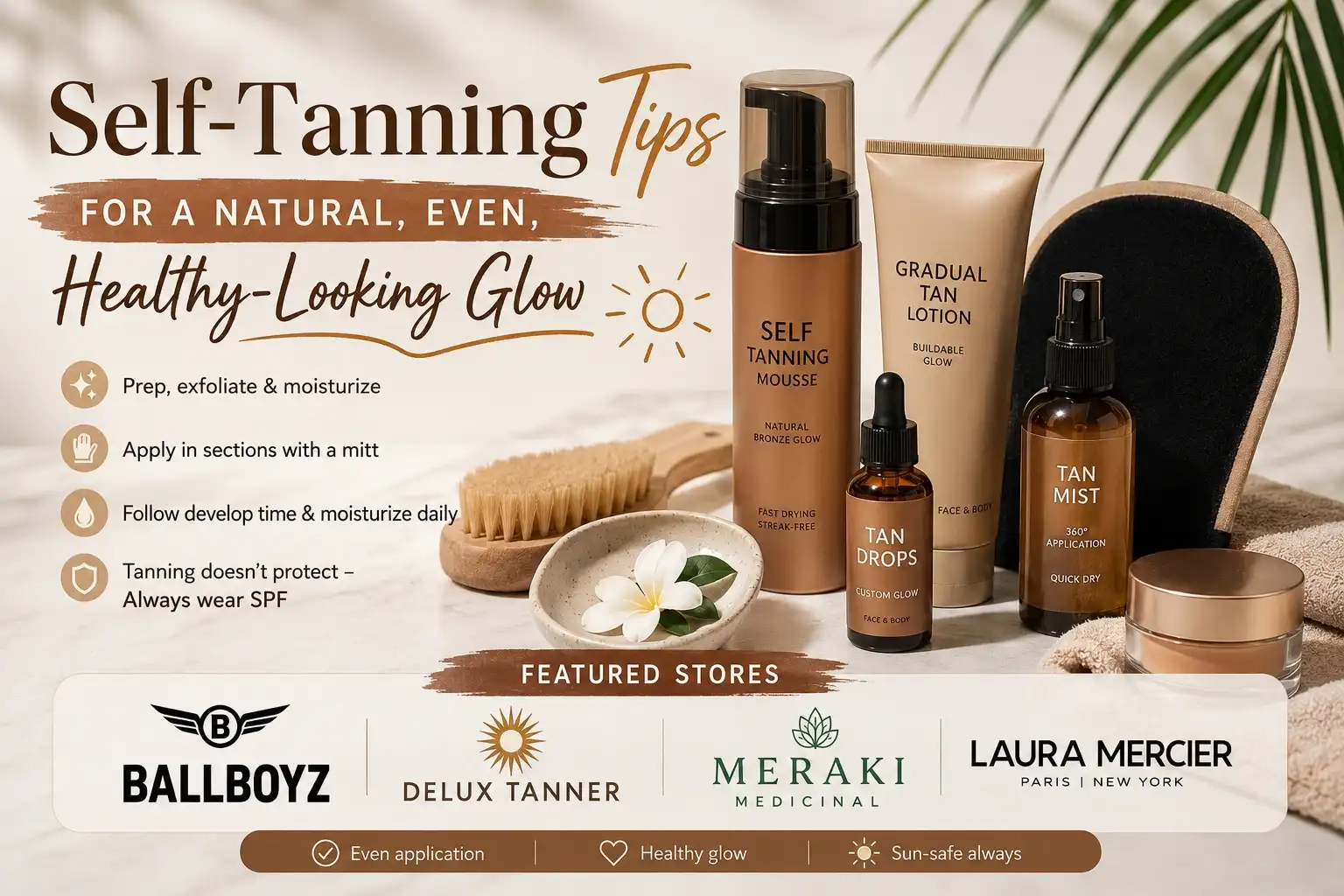
Self-Tanning Tips for a Natural, Even, Healthy-Looking Glow
Learn how to prep, apply, and maintain self-tanner for a natural, streak-free glow, plus expert tips for fixing patches and staying sun-safe.
Recent Blogs
-
Jewellery and Piercings: Expressing Your Personal Style Through Accessories
-
Small Accessories, Big Impact: Ways to Elevate Everyday Outfits
-
How to Style Bracelets, Necklaces and Piercing Jewellery Together
-
Best Everyday Jewellery and Accessories for Every Personal Style
-
The Ultimate Guide to Building a Versatile Jewellery Collection
-
A Practical Guide to Everyday Pet Care: Comfort, Protection, and Hygiene
-
How to Choose the Right Pet Walking Gear for Safety, Comfort, and Control
By William Ashby
·October 09, 2026
Most self-tan disasters have little to do with the product. They come from skipped prep, uneven application, or a rushed first few hours. If you have ever ended up with streaky legs, orange palms, or dark patches on your knees, this guide shows where it goes wrong and how to fix it.
You'll learn how self-tanner works, how to choose a formula, how to prep and apply it, how to make it last, and what to do when it goes wrong. We'll also cover what a tan from a bottle can't do, which is protect you from the sun.
Quick answer: how do you get an even self-tan?
- Exfoliate gently the day before.
- Apply to clean, fully dry skin.
- Moisturize dry, rough areas lightly first.
- Work in small sections with a tanning mitt, blending at the edges.
- Wash your palms right away.
- Follow the product's development time, and moisturize daily afterward.
Most of the work happens before you open the bottle.
How does self-tanner work?
Most self-tanners rely on DHA (dihydroxyacetone), a plant-derived sugar. It reacts with amino acids in the outermost layer of your skin and produces a brown color. Self-tanners contain DHA, a sugar from plants, which reacts chemically with amino acids in the stratum corneum. A clinical review notes that formulations typically contain 3% to 5% DHA.
This explains the most common problems:
- It only colors the surface. Dead skin and dry patches grab more color, so they look darker.
- It fades as skin sheds. Expect it to fade over days, usually around a week depending on the product and your skin. Uneven shedding causes uneven fading.
- It develops over hours. What you see right after applying isn't the final shade, so check the label for timing.
Some formulas also add a cosmetic "guide color" (a bronzer) that you can see as you apply. It washes off, while the DHA-driven color develops underneath.
Which self-tanner formula is right for you?
Choosing a shade: If you're unsure, go lighter and build. A second coat is easy, but removing too much color is slow. Also consider undertone. Neutral or olive-leaning formulas often look more natural than very red-based ones, especially on fair skin.
How should you prep your skin before self-tanning?
Prep decides whether your tan looks even or blotchy.
Exfoliate the day before. Gentle exfoliation removes the dead surface cells that hold on to extra color. Concentrate on knees, elbows, ankles, feet, and hands, and avoid aggressive scrubbing on irritated skin.
One body scrub bar you might consider is from Ballboyz. Retailer listings describe a "Cool Breeze Body Scrub" bar made with coconut oil, olive oil, shea butter, aloe, and chamomile, among other ingredients. Two practical notes:
- Rich, oil-containing bars can leave a light film. Rinse thoroughly and exfoliate the day before tanning rather than right before, so no residue sits between your skin and the tan.
- Check the brand's own product page for current ingredients and details.
Shave or wax at least a day beforehand. Fresh hair removal can leave skin more sensitive, and open follicles can show as dots of color.
Start with clean, completely dry skin. Skip oily or heavily scented products on tan day. Deodorant, perfume, and rich body oils can interfere with even application.
Moisturize only the dry zones. Apply a thin layer of lotion to knees, elbows, ankles, wrists, and feet, and let it absorb. This keeps those areas from going dark.
Step-by-step: how to apply self-tanner
- Wear dark, loose clothes and protect floors and towels. Some tanners stain fabric.
- Put on a tanning mitt. It gives more even coverage than bare hands and protects your palms.
- Work in sections (legs, then torso, then arms) so nothing dries before you blend.
- Use long, even strokes. Use circular motions only to blend.
- Use less product on joints. Dry, creased areas absorb extra color, so buff them with whatever is left on the mitt.
- Blend the borders at the wrists, ankles, neck, and hairline so there are no hard lines.
- Do your back last, with an applicator, or ask someone to help.
- Wash your palms and between your fingers as soon as you've finished.
- Let the tan dry fully before dressing, then wear loose clothing.
How do you self-tan your face?
- Use a face-specific formula or a gradual tanner, and apply less than you think you need.
- Apply with fingertips or a small mitt. Then blend along the hairline, jaw, and ears.
- Keep product away from your eyes, lips, and nostrils.
- Go lighter on eyebrows, or protect them with a thin layer of moisturizer first.
- Patch-test new products behind the ear or on the inner forearm first. DHA products can occasionally cause skin reactions, and fragrances and preservatives in self-tanners may also cause allergic contact dermatitis.
- How do you handle hands and feet?
Use a nearly dry mitt. Apply the lightest amount to the backs of your hands and the tops of your feet, and blend toward the fingers and toes. Skip palms and soles, which absorb color heavily and look unnatural.
What should you do in the first 24 hours (and after)?
- Follow the development time. Different formulas have different timings, so check the label. Avoid water, heavy sweating, and tight clothes until then.
- Moisturize daily. Hydrated skin sheds more evenly, which helps the tan fade gradually.
- Shorten hot showers and pat dry, since scrubbing wears the tan away unevenly.
- Be cautious with chlorine, salt water, and heavy sweat, which may speed up fading.
- Reapply or refresh about weekly, or use a gradual tanner every few days to maintain your shade. Exfoliate gently before each full reapplication.
How do you fix streaks, patches, and orange tones?
Most mistakes are fixable:
- Dark patches on knees, elbows, ankles: Buff gently with a damp cloth or a mild exfoliant, then blend with a little moisturizer.
- Streaks on arms or legs: Exfoliate the streaked area lightly, then apply a thin, even layer of a lighter formula to blend.
- Orange tone: Usually caused by too much product, a very red shade, or poor prep. Exfoliate gently, then use less next time and choose a more neutral shade.
- Stained palms: Scrub gently with a soft brush and mild soap. Prevent it next time with a mitt and immediate washing.
- Small blotchy spots on the face: For minor patches you want to blur for an event, a full-coverage concealer can help. For instance, Laura Mercier's Secret Camouflage Complexion Perfector is described on the brand's site as a 16-hour-wear, full-coverage concealer in adjustable shades for covering discoloration or blemishes. This is a cosmetic cover, not a correction, and the patch will still be there when you wash it off.
How do you finish your look and stay sun-safe?
Self-tanner changes how your skin looks, not how it handles sun. Sunless tanners and bronzers may or may not provide protection from the sun, and only products that contain sunscreen ingredients and carry SPF labeling may provide protection. A clinical review concluded that although DHA has shown very modest photoprotective effects (SPF 1-3), it is not a sunscreen and cannot provide protection from UV exposure.
So even with a fresh tan, you still need daily sun protection.
Many people like to pair their tan with a tinted base that includes SPF. Laura Mercier's Tinted Moisturizer Blurred Matte Oil Free Broad Spectrum SPF 30 is a bestseller on the brand's site, with 15+ shades and an oil-free, matte finish. It may suit oilier skin that doesn't like a dewy look. Two honest caveats:
- Sunscreen only works when applied generously, and a thin layer of makeup rarely reaches the amount used in testing. For long days outdoors, use a dedicated sunscreen as well and reapply.
- Check the shade range against your tanned skin tone. A foundation that matched your untanned skin may look too light.
For a healthy glow on top of a tan, the brand's Bonne Glow Cream Face Palette is described as a vitamin E-infused balm-to-powder palette to sculpt, flush, and illuminate. It's best for adding warmth to cheeks and highlights where self-tanner doesn't create dimension.
Self-tanner vs. tan accelerator: what's the difference?
These two products are often confused, and the difference matters for safety.
- Self-tanner (DHA-based): Colors the skin's surface chemically, with no UV exposure.
- Tan accelerator/intensifier: Used with UV exposure from the sun or sunbeds. It doesn't create a tan on its own.
Delux Tanners is the second type. According to its official site, its formulas contain no DHA and no bronzer. They're described as water-based creams and a jelly meant to be used with sun or sunbed exposure, and the brand states you should wear a separate sunscreen outdoors. Delux also says most people notice a difference within a few sessions. These are the brand's own claims, and we haven't verified results.
Before considering any accelerator, keep this in mind: no cosmetic makes UV exposure safe. The International Agency for Research on Cancer, part of the World Health Organization, classifies UV-emitting tanning devices as carcinogenic to humans. If your priority is a glow without added UV risk, a DHA self-tanner is the lower-risk option, and an accelerator isn't a substitute for sun protection.
If you already spend time in the sun by choice and want to understand accelerators better, Delux's guides and "Find Your Formula" quiz are a place to read ingredient explanations. Delux ships to many countries, so check delivery options for your location.
Safety notes worth knowing
- Avoid eyes, lips, and mucous membranes. Dermatology guidance advises avoiding mucous membranes and broken skin, wearing eye protection, and using a mask to protect the lips and prevent inhalation when using sprays.
- Be careful with sprays and booths. The FDA notes that DHA has not been approved as an all-over spray in commercial spray "tanning" booths, since it can be difficult to avoid exposure of the eyes, lips, or mucous membranes, or internal exposure.
- If you're pregnant or breastfeeding, talk to your doctor before using spray tans. A fact sheet from MotherToBaby notes that sunless tanners are cosmetics, but color additives like DHA must be approved by the FDA, and it isn't approved for use near the eyes or lips or for inhalation.
- Stop using a product if you develop a rash, burning, or swelling.
Your quick self-tan checklist
Frequently Asked Questions
How long does self-tan last?
Typically around a week, depending on the formula, your skin, how often you shower, and how well you moisturize. It fades as the dyed surface cells shed.
Should you exfoliate before self-tanning?
Yes. Exfoliating the day before removes dead cells that would otherwise hold extra color and cause patches.
Why does my self-tan look streaky or orange?
Common causes are skipped exfoliation, uneven application, too much product on dry areas, rushing before the tan has dried, or choosing a shade with a very warm undertone.
Does self-tanner protect from the sun?
No. A DHA tan doesn't protect you from UV. Only products with sunscreen ingredients and an SPF label can offer protection, and you still need to apply them properly.
Can you self-tan your face?
Yes, with a face-specific formula or a gradual tanner. Use a small amount, keep it away from eyes and lips, and patch-test first.
Is self-tanner safe?
Applied to the skin as directed, DHA self-tanners are generally considered a lower-risk alternative to UV tanning. Sprays and booths carry extra concerns about inhalation and exposure of the eyes and lips. If you have sensitive skin or are pregnant, ask your doctor.
How do you fix patchy self-tan?
Gently exfoliate the dark or streaky areas, blend with moisturizer, and reapply a thin, even layer if needed. A concealer can temporarily cover small blemishes.
Conclusion
An even self-tan is mostly about preparation and patience. Exfoliate the day before, apply to clean, dry skin in sections, protect your palms, give the color time to develop, and keep your skin moisturized. Treat sun protection as a separate step, because a tan from a bottle doesn't replace it.